Showing posts with label classroom rules. Show all posts

Sunday, August 16, 2015

Classroom 'Touchstone Creeds'


Last year I made it a personal goal to ask more questions and begin encouraging my students to ask more questions. I feel like these are still things which I need to work on. This year I've been studying about "Growth Mindset" (developing positive attitudes toward & habits of learning which improve learning) and sharing my motivations or purposes for teaching with students.  As part of this I'm introducing classroom "Touchstone Creeds." These aren't negative rules or policies and procedures, they're positive goals which ideally we will all agree to aspire to as a class as sort of a social compact.

Assignment from Summer Course on Character Education:

Now that we have looked at the different positive character traits and virtues, and reflected on the qualities found in a community of virtue, decide on a Touchstone Creed for your classroom that will be the vision that will frame everything that happens inside your classroom.

In general, a Touchstone is a basis of comparison, a reference point against which other things can be evaluated. It sets the measure for all subsequent worth.


A Character Touchstone is a concise, memorable guide to right behavior. It is not a complete moral system, but a summary that is easy to remember and to teach. It is a short list of rules to which you can refer automatically in moments of stress or indecision. In a classroom (or school-wide) a Touchstone provides resonance, sets expectations and unifies.

These are the "Touchstone Creeds" I developed for my classes this year:

One of the concepts I try to stress in Civics class is that we always need to consider that Civic Virtue = General Welfare = Common Good. Some of the principles I spend the most time teaching in Civics include Equality, Rights,Social Contract, Liberty, Justice, and Unity. Some of the things that my middle school colleagues and I at Boyer Valley have discussed that we hope to instill in our students are Respect, Responsibility, Empathy & Compassion (Caring).

I REALLY want to just adopt this quote from Teddy Roosevelt- "Look up, not down- Look out, not in- Look forward, not backward- and lend a hand."

MS CIVICS CLASSES (8th Grade):

We're all responsible making this a learning space
We respect everyone's rights & dignity
We show grit to grow & to try again when we fail
Everyone matters, everyone's voice should be heard


I've always used structural frameworks to teach visual art. Discipline Based Art Education

(DBAE) consists of Art History, Design/Aesthetics, of course actual Art Making and Art Criticism. Art Criticism involves critical thinking skills such as description, analysis, interpretation and evaluation. It's always a challenge to get students to talk about each other's work in a positive, supportive atmosphere. You always imagine a "creative community," almost like a miniature artists' colony in your classroom. Unfortunately immaturity and social dynamics don't always permit that. Just a few of the virtues that I hope to have my Art students adopt are Respect, Responsibility, Caring, Expression, Vision, Curiosity, Creativity, Aesthetics. Those and keeping your hands off of other people's projects and cleaning up after themselves!

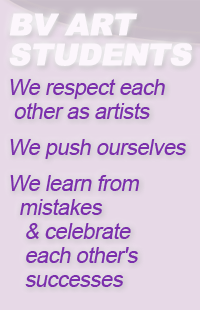
BV ART STUDENTS (7th-12th Grades):

We respect each other as artists
We push ourselves
We learn from mistakes
and celebrate each other's successes

PURPOSE DRIVERS

The following are more mission statements than touchstones since they're more about the purpose for each organization rather than about fostering a culture or climate within the classroom. The Cheerleading one is revised a little from one we developed back in 2002. The only thing I really changed was replacing "Stirring-Up Spirit" with "Building Bulldog Spirit."

I've wanted to create something for our Yearbook for some time. We had had a couple old tag lines; "preserving Bulldog memories for over 90 years," and "Student-Produced Yearbook," but neither one seemed very fun or inspiring. I may ask student staffers to either "ratify" or replace it though. We'll see how it goes.


Wednesday, February 1, 2012

Responsible, Respectful, & Fun to be Around

The following is something that I'm developing for all of my classes. I began the school year with something similar to this in my 8th grade Civics classes. Recently we've had some trouble getting along well in some of my other classes, so I felt the need to address issues of classroom behavior. Other teachers and/or psychologists and counselors may recognize the influence of Dr. William Glasser's "control theory," and Jim and Dr. Charles Fay's "love and logic" concepts.

RESPONSIBLE
People who learn how to meet these needs without depriving others of opportunities to have their needs met are considered "responsible." If you either can't get these needs met at all, or are constantly tying to meet your own needs with no regard for anybody else's are pretty much "irresponsible."

If I tell you that you've been "responsible" or "irresponsible," you'll know that your classroom behavior has been helpful, positive, productive, constructive and contributing (responsible), or distracting, disruptive, inappropriate or destructive (irresponsible).

When you're irresponsible, it will be harder for you to meet your own needs. Irresponsible behavior makes it harder for the rest of us to get our needs met. You forfeit meaningful connections when you behave irresponsibly.

You are responsible for your own learning, your homework, your performance on tests and quizzes and ultimately for your own grade. Not completing assignments, not turning them in, and not studying are irresponsible. Responsibility will help you adjust to high school and college. Responsibility will help you succeed in life.

Response-Able- another thing to consider about responsibility is that none of us can really control anyone else besides ourselves. The only one you can really control is yourself. If you are able to control your responses, how you react to the way others treat you or behave toward you, you will have shown maturity. If you try to get-even or get-back at someone who mistreats you, the situation will only escalate and get worse. Half the time, when a bully tries to provoke you, they're looking for a reaction. When you over-react, you give them power and forfeit your own.

RESPECTFUL
We need to refrain from interfering with other people's projects, we need to value, honor, or esteem every member of the classroom as someone entitled to just as much dignity as ourselves and we need to recognize that everyone else in the room has the same needs and rights that we do.

What should we respect?
Respect THINGS:

  1. Private Property- other people's Ceramics projects, their clothing, books, bags, etc.
  2. Public Property- WE ALL SHARE THINGS like the supplies, the clay, tools, glazes, brushes, paper, canvas, sinks etc. If any one person mistreats or abuses them, everyone suffers.


Respect PEOPLE:

  1. Respect YOURSELF- The way that you behave sends an unconscious signal to everyone about how you feel about yourself and how you believe you deserve to be treated. If you bully others, are impolite, or insensitive- you're basically telling everyone that YOU don't deserve dignity, kindness, manors, ore respect.
  2. Respect CLASSMATES- Everyone in the room has feelings, a history and a future. Everyone in the room has pretty much the same rights and needs that you do. They need to be accepted, they need to be useful, they need to be safe, they need to have fun, they need to be able to make decisions for themselves and they need to have some impact or influence on others. When you trample other people's rights and needs, you endanger your own rights. As Martin Luther King Jr. once said, "injustice ANYwhere is a threat to justice EVERYwhere." In other words, treat others the way you expect to be treated.
  3. Respect MR. MALLORY- Even if you genuinely believe in "Anarchy," the absence or denial of any authority or established order as a political philosophy, you must concede two things; 1) that I am a human being and have the same needs and rights that you do as individuals (see "respect for CLASSMATES" above) and 2) that as the trained and experienced expert in Art as an academic discipline, you NEED to give me your attention and deference at times so that I can effectively facilitate your learning. In other words, for all of us to learn, you need to listen and follow directions. I'm here to teach you and help you, but I can't do that without your cooperation.

FUN TO BE AROUND
My hope is to foster a CULTURE that is creative and constructive. We want to be able to experiment and express ourselves, but we want to do that in a way that promotes learning and improving our knowledge, understanding and skills development. In order to best support these two values of creativity and building one another up, we need to maintain a certain climate.

I want the Art Room to have a CLIMATE that is safe, supportive and positive. For this to happen, we must consider the needs and rights of others, not just our own. We must respect each other and each other's personal property and the classroom/commonly-held or "public" property that we all share.

It may be "fun" for someone to bully others, but it's probably not fun for others to be around them. Generally, "irresponsible" people are not fun to be around.

You can help improve our school's climate by respecting others, supporting others, and being as positive as you can. Martin Luther King Jr. also said that "Most people ... are thermometers that record or register the temperature of majority of opinion, not thermostats that transform or regulate the temperature of society."

When you react to how people mistreat you or to "get-back" at someone, you're being a thermometer- just reflecting what goes on at your school. But if you either proactively do things to support or improve the climate, you set the tone like a thermostat sets the temperature!

Again, it's RESPONSIBLE to try to meet your needs and exercising your rights, while also respecting the needs and rights of others. It's IRRESPONSIBLE to disregard or even VIOLATE the rights and needs of others while selfishly thinking only of your own needs and rights.